Your shopping cart is empty!

Red clover isoflavones: what the research really shows
Published: 25/08/2026
Times Read: 525
Comments : 0
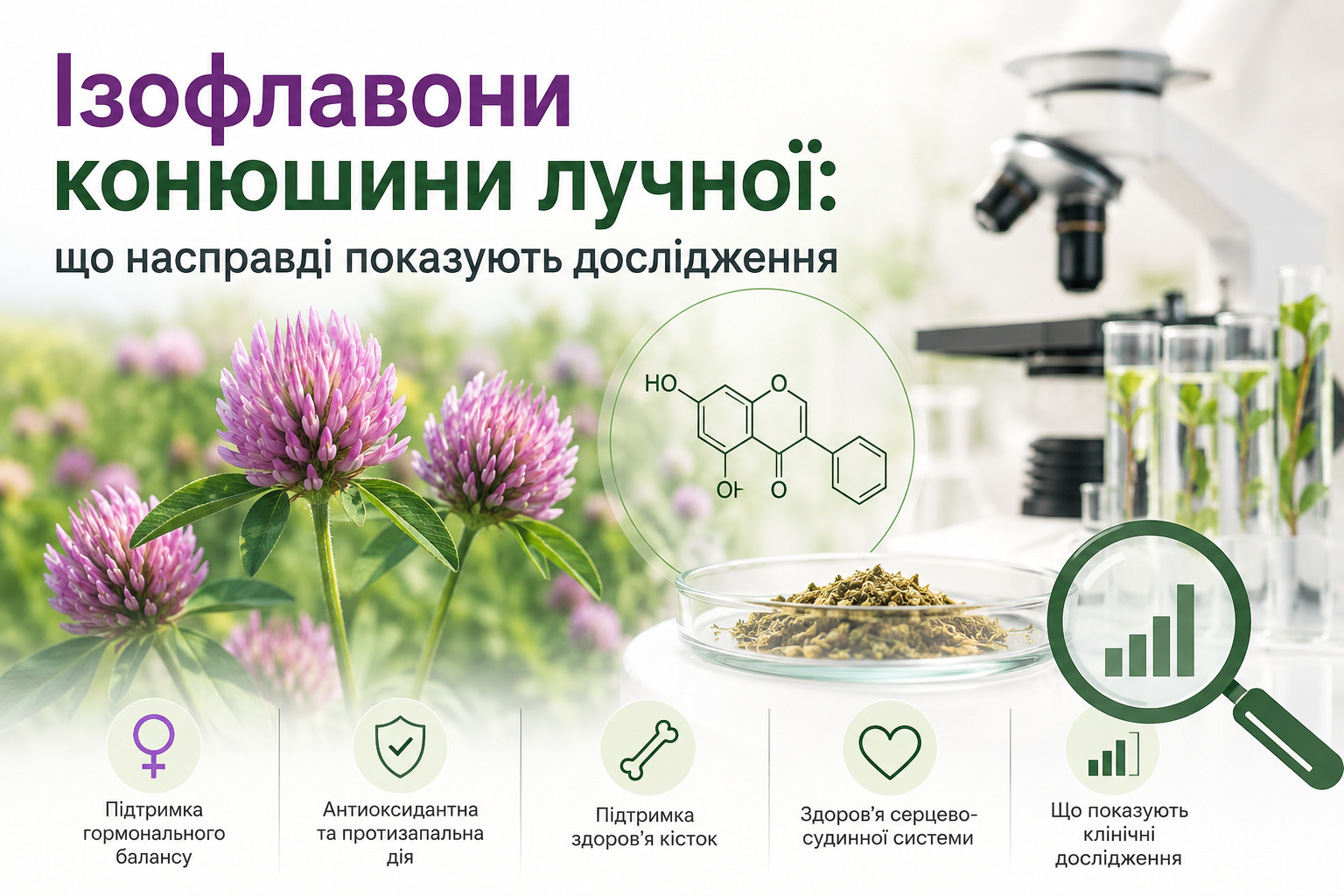
Isoflavones from meadow clover (Trifolium pratense L.) are among the most studied plant phytoestrogens after soy. The main compounds here are biochanin A and formononetin, which are partially converted in the body to genistein and daidzein, the same isoflavones found in soy, only in a different initial ratio. Due to their structural similarity to estrogen, they have been studied for decades as a possible herbal support for women's diets during periods of age-related hormonal changes.
But there is no single picture in the studies: some works record a moderate effect, others - no difference from placebo. Let's break it down by sources: what exactly, at what doses and under what conditions was it shown.
What are clover isoflavones and how do they differ from soy isoflavones?
Isoflavones are plant polyphenols from the group of phytoestrogens. In meadow clover, biochanin A and formononetin predominate, while in soy, genistein and daidzein. These are not separate substances “from scratch”: in the intestine, biochanin A is partially metabolized into genistein, and formononetin into daidzein, so the final set of active metabolites in the blood partially overlaps with soy, although the starting material is different. Standardized clover extracts fix the total isoflavone content in percentage to control the dose regardless of fluctuations in the raw material.
Mechanism of action: why the effect is mild and selective
Clover isoflavones bind preferentially to estrogen receptor type β (ER-β) rather than the α type, which is dominant in breast and endometrial tissues. ER-β is more abundant in blood vessels, bone, and the central nervous system, which is one reason why the potential effects are more likely to affect hot flashes, bone, and mood than reproductive tissues, and why it is structurally weaker than the effects of estrogen itself.
The second factor of variability is the intestinal microbiota. Part of daidzein in the intestine, under the influence of certain bacteria, is converted into equol, a metabolite with higher estrogenic activity than the original compound. But not everyone has the ability to produce equol: according to estimates from studies of isoflavone bioavailability, “equol producers” are approximately one third to one half of the population, depending on the composition of the microbiota and diet. This is one of the reasons why the same extract has different effects in different people.
Hot flashes and menopause symptoms: conflicting data
This is where the most direct research has accumulated — and the results are inconsistent.
Positive results. Van de Weijer and Barentsen (2002) in a placebo-controlled study of 30 women with frequent hot flashes showed that 80 mg of isoflavones per day for 12 weeks statistically significantly reduced the frequency of hot flashes by 44% more than placebo. Lipovac et al. (2012) in a separate study of postmenopausal women also reported significant improvements in vasomotor symptoms at a dose of 80 mg per day.
Null result. The ICE study (Tice et al., JAMA, 2003)—one of the largest (252 participants)—compared 82 mg of isoflavones per day (Promensil) and 57 mg per day (Rimostil) with placebo for 12 weeks. The Promensil group reduced hot flashes more rapidly than placebo (statistically significant, p=0.03), but the authors concluded that neither drug had a clinically meaningful effect on hot flashes or other menopausal symptoms.
Systematic reviews have attempted to reconcile these discrepancies. A meta-analysis by Ghazanfarpour et al. (2016) found an overall modest effect of clover on hot flashes. A later meta-analysis (Kanadys et al., 2021) clarified the conditions under which the effect was most consistent: a dose of 80 mg isoflavones per day, a duration of 12 weeks, and a baseline hot flash rate of 5 per day. That is, studies with lower doses or shorter durations are more likely to show no difference from placebo—which is consistent with the null result of ICE.
Bones and lipid profile
Atkinson et al. (2004) gave 205 women aged 49–65 years clover isoflavones (a total of about 43.5 mg per day: biochanin A, formononetin, genistein, and daidzein) for 12 months and recorded that the loss of bone mineral density and bone mineral content in the lumbar spine was significantly less than in the placebo group—that is, the extract did not increase bone density, but slowed its natural loss.
Lambert et al. (2017) tested fermented clover extract (34 mg isoflavones per day, divided into two doses) for 12 weeks in women with frequent hot flashes—and in addition to significantly reducing the frequency and intensity of hot flashes, additional study data also noted a slowdown in bone loss in this group. This is a relatively new study with a small sample size, so the results should be considered preliminary.
Regarding the lipid profile, the data are less consistent: some studies report a decrease in total cholesterol with the intake of clover isoflavones, while changes in LDL, HDL, and triglycerides are less pronounced and not always statistically significant.
A separate series by the same research group (Lipovac et al.) studied 80 mg of clover isoflavones per day for 90 days in a crossover design in approximately 100 postmenopausal women. This protocol reported reductions in standardized anxiety and depressive mood scores, as well as improvements in subjective skin and mucous membrane health, compared with placebo. These are not large-scale studies, and their results should be considered limited, preliminary evidence rather than definitive evidence.
Who should be careful?
Due to phytoestrogenic activity, consultation with a doctor before taking is recommended for women with a personal or family history of breast cancer. Caution is also appropriate for pregnant and lactating women, those who are simultaneously undergoing hormone therapy (in particular HRT), as well as people with individual sensitivity to plant components.
Frequently asked questions
Are clover isoflavones hormones?
No, these are plant polyphenols (phytoestrogens), structurally similar to estrogen and capable of weakly interacting with its receptors, but they are not hormones in the literal sense and their activity is much lower than estrogen itself.
How does meadow clover differ from soybeans in terms of isoflavone composition?
In clover, biochanin A and formononetin predominate, in soybeans, genistein and daidzein; in the intestine, biochanin A and formononetin are partially metabolized into genistein and daidzein.
How long did clover isoflavone studies typically last?
Most controlled studies have lasted from 12 weeks to 12 months; meta-analyses have shown that significant effects on hot flashes were more consistently seen with durations of 12 weeks or longer.
What is equol and why doesn't everyone feel the effects?
Equol is a metabolite of daidzein with increased estrogenic activity, which is formed in the intestine only in the presence of certain bacteria; not every person has the ability to produce it ("equol producers"), so the effect of the same extract varies individually.
Can clover isoflavones be combined with hormone replacement therapy?
This should be discussed with your doctor individually: both approaches affect estrogen receptors, and simultaneous use requires medical supervision, not an independent decision.
Who is not recommended to take clover isoflavones without consulting a doctor?
Women with a personal or family history of breast cancer, pregnant women, lactating women, and those undergoing hormone therapy.
Do clover isoflavones affect men?
Most controlled studies were conducted on postmenopausal women; there are no separate qualitative studies of the effects on the male body in the reviewed sources, so there is currently no basis for drawing conclusions for men.
Sources
- Van de Weijer PHM, Barentsen R. (2002). Isoflavones from red clover (Promensil) significantly reduce menopausal hot flush symptoms compared with placebo. Maturitas. PubMed
- Lipovac M. et al. (2012). The effect of red clover isoflavone supplementation on vasomotor and menopausal symptoms in postmenopausal women. Gynecological Endocrinology. PubMed
- Tice JA et al. (2003). Phytoestrogen supplements for the treatment of hot flashes: the Isoflavone Clover Extract (ICE) Study. JAMA. PubMed
- Ghazanfarpour M. et al. (2016). Red clover for treatment of hot flashes and menopausal symptoms: a systematic review and meta-analysis. Journal of Obstetrics and Gynecology. PubMed
- Kanadys W. et al. (2021). Evaluation of Clinical Meaningfulness of Red Clover Extract to Relieve Hot Flushes and Menopausal Symptoms. Nutrients. PMC
- Atkinson C. et al. (2004). The effects of phytoestrogen isoflavones on bone density in women. American Journal of Clinical Nutrition. PubMed
- Lambert MNT et al. (2017). Combined Red Clover isoflavones and probiotics potently reduce menopausal vasomotor symptoms. PLoS One. PMC
- Lipovac M. et al. (2010). Improvement of postmenopausal depressive and anxiety symptoms after treatment with isoflavones derived from red clover extracts. Maturitas. PubMed
- Lipovac M. et al. (2011). Effect of Red Clover Isoflavones on Skin, Appendages, and Mucosal Status in Postmenopausal Women. Obstetrics and Gynecology International. PMC
Dietary supplement. Not a medicine. Consult a doctor before use.
Products related to this post
Comments
Information
Customer Service
Extras
My Account


Sports nutrition manufacturer in Ukraine StarkPharm © 2026