Your shopping cart is empty!

PQQ: The Antioxidant That Grows New Mitochondria — Truth or Marketing?
Published: 25/08/2026
Times Read: 450
Comments : 0
PQQ, or pyrroloquinoline quinone, is a compound that studies have described as being able to stimulate the formation of new mitochondria in cells, rather than just maintaining the function of existing ones. This distinguishes it from classic mitochondrial supplements such as coenzyme Q10, which acts inside existing mitochondria. PQQ is not synthesized endogenously in mammals and comes only with food - it is found in trace amounts in kiwi, spinach, parsley, green tea, natto.
Scientific interest in PQQ is based on two distinct lines of evidence: mechanistic studies in cells and animals that explain how the substance could theoretically affect mitochondria, and a small number of controlled human studies, mostly in Japan. Let's take a look at what's proven and what's still hypothetical.
What is PQQ and how is it different from CoQ10?
PQQ (pyrroloquinoline quinone) is an aromatic tricyclic o-quinone molecule, first described as a redox cofactor of bacterial enzymes. In humans and animals, PQQ's own biosynthesis has not been detected, so the compound is classified as a vitamin-like substance, although it does not have the status of a classical vitamin - PQQ deficiency syndrome, characteristic of a lack of true vitamins, has not been described in humans.
The key difference from coenzyme Q10 is not only in its chemical structure, but also in its role. CoQ10 works as an electron carrier in the respiratory chain of existing mitochondria. PQQ, according to cell studies, acts more like a signaling molecule that triggers the formation of new mitochondria. In addition, PQQ is described as an extremely stable redox agent, capable of participating in thousands of cycles of redox reactions before being destroyed - in comparison, vitamin C can withstand only a few such cycles.
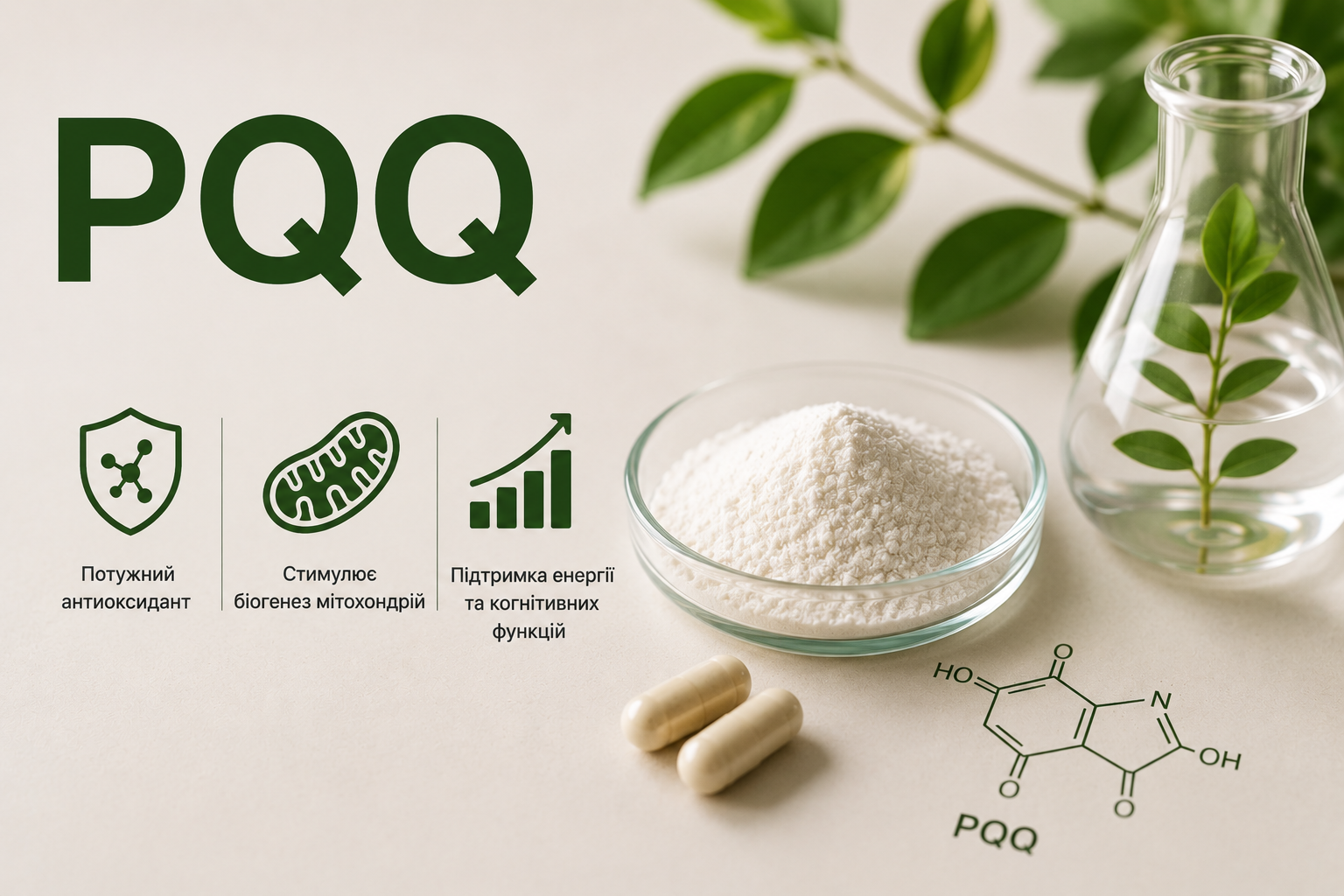
Mechanism of action: how PQQ stimulates mitochondrial biogenesis
The main mechanistic study here is the work of Chowanadisai et al. (2010) on mouse liver cell cultures. The authors showed that PQQ activates the signaling protein CREB (through its phosphorylation), which, in turn, increases the expression of PGC-1α, a protein considered a master regulator of mitochondrial biogenesis. In cell cultures treated with PQQ, an increase in the activity of mitochondrial enzymes, the amount of mitochondrial DNA, and cellular respiration was recorded.
It is important to be clear about the status of this study: it is a mouse cell culture study, not a human study. It explains a plausible mechanism, but does not by itself prove that taking PQQ in humans will produce similar effects in their bodies—clinical studies are needed, as discussed below.
Memory and cognitive function: what controlled studies have shown
There is already direct human data, although the samples are still small and mostly Japanese. Shiojima et al. (2022) conducted a randomized, double-blind, placebo-controlled study in 64 healthy Japanese men aged 40–80 years: 21.5 mg PQQ per day for 12 weeks. The PQQ group recorded significant improvements in cognitive tests (Cognitrax) and the Forgetfulness Questionnaire compared to placebo; no side effects were observed.
Tamakoshi, Ikemoto et al. (2023) conducted a separate double-blind placebo-controlled study in adults aged 20–65 years: 20 mg PQQ per day. In the older group (41–65 years), composite and verbal memory significantly improved after 12 weeks of treatment. In the younger group (20–40 years), improvements in cognitive flexibility and information processing speed were recorded earlier, as early as 8 weeks.
Both studies are controlled and provide a consistent picture for doses of about 20–21.5 mg per day when taken for 8 to 12 weeks, but the number of such studies is still small, and the samples are mostly homogeneous in ethnicity and age, so it is premature to extend the conclusions to all population groups.
Sleep, fatigue and inflammatory markers: preliminary data
Nakano et al. (2012) conducted an open-label, placebo-controlled study in a small group of adults: 20 mg PQQ per day for 8 weeks. They recorded improvements in stress, fatigue, and sleep quality questionnaires. The lack of a control group and blinding is a significant limitation: without a placebo, it is impossible to exclude the expectation effect, so these data should be taken as preliminary, not as proof of effect.
Harris et al. (2013) investigated short-term administration of PQQ (about 0.3 mg/kg body weight per day, i.e. approximately 20 mg for an average-weight person) for only 3 days in 10 volunteers, also without a placebo group. They recorded a decrease in inflammatory markers - C-reactive protein and interleukin-6. This study is even smaller in scale than the previous one and its results should be considered only as hypothesis-generating.

Who might be interested in this and what to consider
PQQ is of interest primarily to people seeking support for cognitive function, energy metabolism, or antioxidant protection as part of a balanced diet. It is recommended to consult a doctor before taking it, especially for pregnant women, lactating women, people taking medications on a regular basis, as well as those with chronic diseases or individual sensitivity to the components of the supplements. Children are not recommended to take PQQ supplements without a doctor's prescription.
Frequently asked questions
PQQ (pyrroloquinoline quinone) is a vitamin-like redox-active compound; it is not considered a classical vitamin, as no clear PQQ deficiency syndrome has been described in humans.
How is PQQ different from coenzyme Q10?
CoQ10 transports electrons in the respiratory chain of existing mitochondria, while PQQ, according to cell studies, triggers the CREB/PGC-1α signaling pathway, which stimulates the formation of new mitochondria.
How long did the human studies of PQQ last?
Controlled cognitive function studies have lasted 8–12 weeks at doses of 20–21.5 mg/day; some previous studies of sleep and inflammatory markers have been shorter (3 days–8 weeks) and have not been placebo-controlled.
Is PQQ proven to improve memory?
Two independent controlled studies have shown improvements in cognitive performance at doses of around 20 mg per day for 8–12 weeks, but the number of such studies is still limited, so it is too early to draw definitive conclusions for all populations.
Is there any research on the effects of PQQ on sleep and fatigue?
There is one open-label, non-placebo-controlled study that showed improvements in stress, fatigue, and sleep; due to the lack of a control group, this result is considered preliminary.
Does PQQ have side effects?
In controlled studies with doses of 20–21.5 mg per day for 12 weeks, no side effects other than placebo were recorded, but the samples are still small, so individual sensitivity cannot be ruled out.
Sources
- Chowanadisai W. et al. (2010). Pyrroloquinoline quinone stimulates mitochondrial biogenesis through cAMP response element-binding protein phosphorylation and increased PGC-1alpha expression. Journal of Biological Chemistry. PubMed
- Shiojima Y. et al. (2022). Effect of Dietary Pyrroloquinoline Quinone Disodium Salt on Cognitive Function in Healthy Volunteers: A Randomized, Double-Blind, Placebo-Controlled, Parallel-Group Study. Journal of the American Nutrition Association. PubMed
- Tamakoshi M., Ikemoto K. et al. (2023). Pyrroloquinoline quinone disodium salt improves brain function in both younger and older adults. Food & Function. Food & Function (RSC)
- Nakano M. et al. (2012). Effects of Oral Supplementation with Pyrroloquinoline Quinone on Stress, Fatigue, and Sleep. Functional Foods in Health and Disease. Functional Foods in Health and Disease
- Harris CB et al. (2013). Dietary pyrroloquinoline quinone (PQQ) alters indicators of inflammation and mitochondrial-related metabolism in human subjects. Journal of Nutritional Biochemistry. ScienceDirect
Dietary supplement. Not a medicine. Consult a doctor before use.
Products related to this post
Comments
Information
Customer Service
Extras
My Account


Sports nutrition manufacturer in Ukraine StarkPharm © 2026