Your shopping cart is empty!

Nicotinamide Riboside: Does Increasing NAD+ Really Provide Tangible Benefits?
Published: 26/08/2026
Times Read: 426
Comments : 0
Nicotinamide riboside (NR) is a form of vitamin B3 that cells use to replenish NAD+ (nicotinamide adenine dinucleotide), a coenzyme involved in virtually all cellular energy metabolism. Interest in NR has grown since the discovery of the so-called NAD+ recycling pathway, in which this form of the vitamin is converted to NAD+ much more efficiently than some other forms of B3.
NR is one of the most studied NAD+ precursors to date: there is both a large dose-dependent safety study and several functional studies in humans with different, sometimes contradictory results. Let's analyze them sequentially.
What is nicotinamide riboside and how is it different from other forms of vitamin B3?
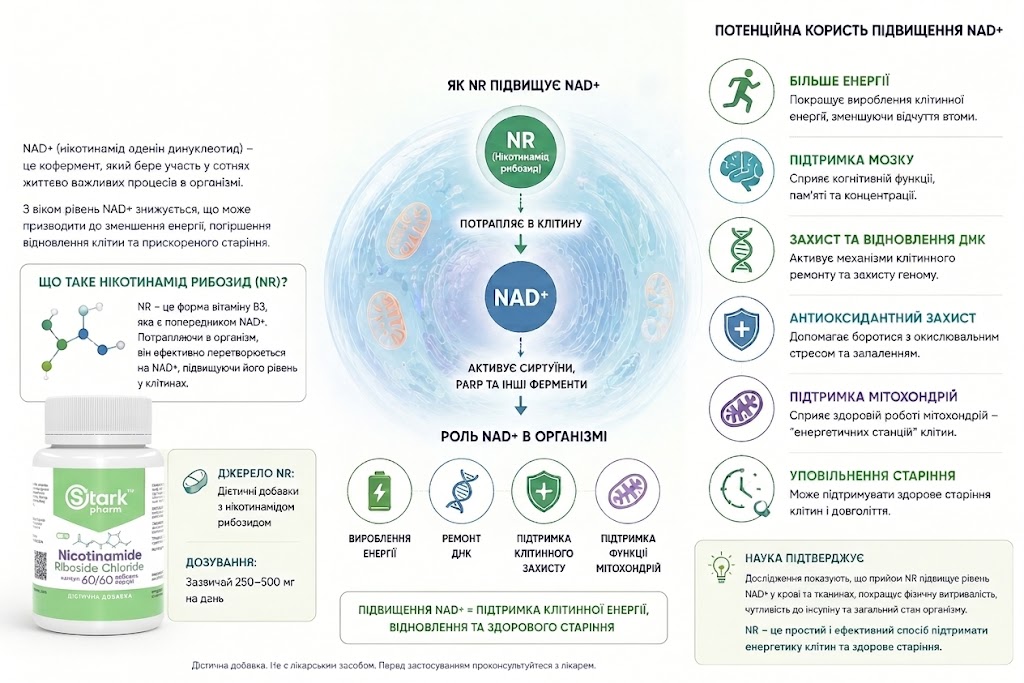
Vitamin B3 exists in several forms—nicotinic acid, nicotinamide, and nicotinamide riboside—and all are ultimately converted to NAD+, but by different routes. Nicotinamide riboside uses a so-called salvage pathway: the enzymes NRK1 and NRK2 convert NR directly to nicotinamide mononucleotide (NMN), which then converts to NAD+, bypassing some of the intermediate steps that are common to the other forms. Unlike nicotinic acid, which causes flushing in high doses, NR has not been shown to have this effect in studies.
Mechanism of action
NAD+ is a coenzyme required for the function of mitochondrial enzymes of the respiratory chain, as well as for the activity of sirtuins, proteins involved in the regulation of cellular stress, DNA repair, and metabolic adaptation. According to preclinical studies, tissue levels of NAD+ decrease with age, which formed the basis of the hypothesis of the potential benefit of NAD+ precursors for supporting cellular metabolism in old age. However, this is mainly a preclinical hypothesis - the extent to which an increase in NAD+ in humans translates into real functional benefits is shown only by individual clinical studies below.
The largest dose-response study: what 100, 300, and 1000 mg showed
| NR dose/day | Increase NAD+ for 2 weeks | NAD+ increase at 8 weeks |
|---|---|---|
| 100 mg | +22% | +10% |
| 300 mg | +51% | +48% |
| 1000 mg | +142% | +139% |
Conze et al. (2019) conducted the largest dose-response study of NR to date: 140 healthy, overweight individuals were given 100, 300, or 1000 mg of nicotinamide riboside chloride per day for 8 weeks. The results were a clear dose-response: the higher the dose, the stronger and faster the increase in whole blood NAD+ levels, and the increase remained stable until the end of the study. The safety profile was good: there was no skin flushing, no significant differences in side effects between the NR and placebo groups, and no negative effect on LDL cholesterol. This study was the basis for the EFSA expert opinion on the safety of this form of vitamin B3.
Does increasing NAD+ translate into functional benefit: conflicting data
It is important to honestly separate two different questions here: does NAD+ increase (yes, consistently and dose-dependently) and does it provide a tangible functional benefit (here the data is much less convincing).
Dollerup et al. (2018) administered 2000 mg of NR daily for 12 weeks to obese, insulin-resistant men. The study confirmed the safety of this high dose and also showed some changes in fat mobilization and reduced liver fat in some participants — but **no significant improvement in insulin sensitivity or overall carbohydrate metabolism**, despite a dose that far exceeds the usual daily intake of supplements.
Remie et al. (2020) administered 1000 mg NR daily for 6 weeks to healthy obese subjects in a crossover design. Skeletal muscle NAD+ metabolites increased, and there were minor changes in body composition and resting metabolic rate, but **no other significant metabolic effects (particularly on mitochondrial function) were observed**.
This means that even at doses several times higher than 300 mg, researchers consistently see increases in NAD+, but do not always see the expected functional benefit for metabolic health. This is an important nuance to consider when presenting biomarker increases as an end in themselves.
Muscles and inflammation: preliminary data
Elhassan et al. (2019) studied 12 men aged 70–80 years who were given 1000 mg of NR per day for 21 days in a crossover placebo-controlled design. The skeletal muscle NAD+ metabolome did indeed increase and the levels of some circulating inflammatory cytokines decreased—the first direct evidence that oral NR is specifically available to muscle tissue in older adults. However, the researchers did not find changes in muscle mitochondrial bioenergetics, and RNA sequencing even showed a decrease in the expression of energy metabolism genes—a result that was contrary to initial expectations. The authors emphasize that the study is short (21 days) and needs to be confirmed in clinically relevant models.

Nicotinamide riboside is of interest primarily to people seeking support for cellular energy metabolism within a balanced diet, especially in the context of age-related changes. It is not recommended for pregnant women, lactating women, and children under 18 years of age — there is no data on its use in these groups in the reviewed studies. If you have chronic diseases or are taking medications on a regular basis, you should consult your doctor first. In the above studies, no serious side effects were recorded, even at doses significantly exceeding the typical daily portion of supplements.
Frequently asked questions
What is nicotinamide riboside?
This is a form of vitamin B3 that, through the recycling pathway, is efficiently converted into NAD+, a coenzyme necessary for cellular energy metabolism.
How is NR different from nicotinic acid or nicotinamide?
All three forms are ultimately converted to NAD+, but by different metabolic pathways; unlike nicotinic acid, NR did not cause flushing in studies.
Does increasing NAD+ mean health benefits?
Not necessarily: in several studies, NAD+ increased dose-dependently and consistently, but significant improvements in functional indicators - insulin sensitivity, mitochondrial function - were not always recorded against this background.
How long did the NR human studies last?
From 3 weeks (muscle study in elderly men) to 12 weeks (insulin sensitivity study), with doses ranging from 100 to 2000 mg per day.
Are there any side effects of nicotinamide riboside?
In the studies conducted, including at doses significantly exceeding the typical daily dose, no serious side effects or significant differences from placebo were recorded.
Who is not recommended to take NR without consulting a doctor?
Pregnant women, lactating women, children under 18 years of age, and people who take medications on a regular basis.
Sources
- Conze D., Brenner C., Kruger CL (2019). Safety and Metabolism of Long-term Administration of NIAGEN (Nicotinamide Riboside Chloride) in a Randomized, Double-Blind, Placebo-controlled Clinical Trial of Healthy Overweight Adults. Scientific Reports. Nature
- Dollerup OL et al. (2018). A randomized placebo-controlled clinical trial of nicotinamide riboside in obese men: safety, insulin-sensitivity, and lipid-mobilizing effects. American Journal of Clinical Nutrition. PubMed
- Remie CME et al. (2020). Nicotinamide riboside supplementation alters body composition and skeletal muscle acetylcarnitine concentrations in healthy obese humans. American Journal of Clinical Nutrition. PubMed
- Elhassan YS et al. (2019). Nicotinamide Riboside Augments the Aged Human Skeletal Muscle NAD+ Metabolome and Induces Transcriptomic and Anti-inflammatory Signatures. Cell Reports. PMC
Dietary supplement. Not a medicine. Consult a doctor before use.
Products related to this post
Comments
Information
Customer Service
Extras
My Account


Sports nutrition manufacturer in Ukraine StarkPharm © 2026