Your shopping cart is empty!

Bacopa monnieri is an Ayurvedic herb that is being tested for its ability to improve memory.
Published: 25/08/2026
Times Read: 366
Comments : 0
Bacopa monnieri is a perennial wetland plant that has been used in Ayurvedic medicine for centuries as a medhya rasayana, a memory and intelligence enhancer. Over the past 25 years, this tradition has been tested in controlled human studies, and enough data has been accumulated to be able to speak objectively about what these studies have shown, at what doses, and after what time the effect appeared.
The active substances of bacopa are considered to be bacosides, a group of triterpene saponins (mainly bacoside A and bacoside B), the content of which in standardized extracts is controlled separately from the total mass of the extract.

What are Bacopa Monnieri and bacosides?
Bacopa monnieri is a plant of the Plantaginaceae family that grows in humid and marshy places in tropical regions, particularly in India. In traditional Ayurveda, it was used to improve memory, for insomnia, and as a sedative. Researchers attribute the plant's main pharmacological activity to bacosides, saponins whose content in the raw material varies significantly, so studies and supplements use extracts standardized to a specific percentage of bacosides. However, different commercial extracts (e.g., CDRI-08, BacoMind, Keenmind) differ in the standardization method and the ratio of individual bacosides, so direct comparisons between studies are not always correct.
Mechanism of action
According to preclinical studies, bacosides can affect several systems simultaneously. First, they are associated with modulation of the cholinergic system - a neurotransmitter system involved in learning and memory processes. Second, there is evidence of increased expression of neurotrophic factors, in particular BDNF (brain-derived neurotrophic factor), which theoretically contributes to the formation of new synaptic connections and the branching of neuronal dendrites. Third, bacosides are attributed to antioxidant effects at the level of cell membranes - the ability to stabilize membranes from damage by free radicals. It is important to understand that most of these mechanisms have been described in cellular and animal models; they explain a plausible pathway of action, but the strength of the effect on human cognitive functions is determined by individual clinical studies below.
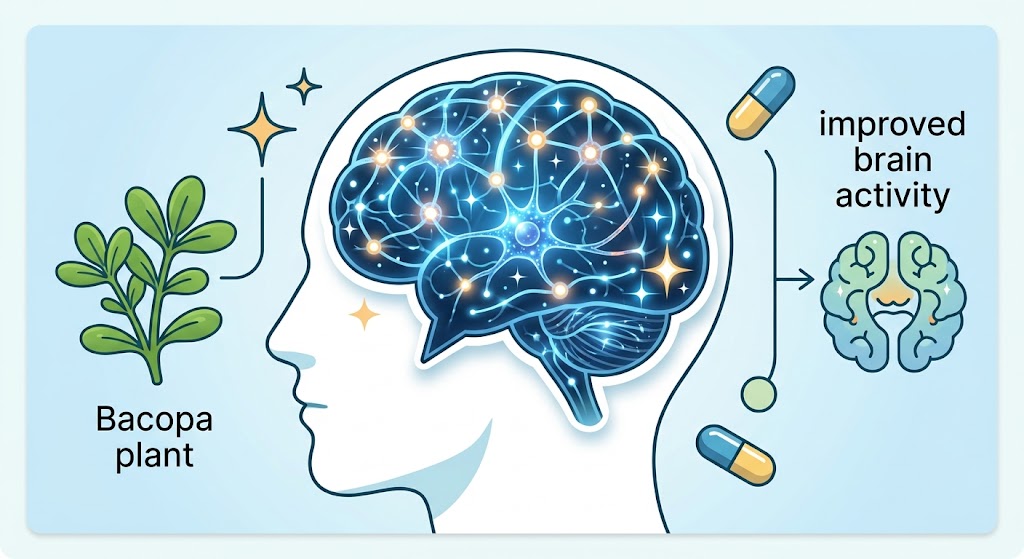
Memory and learning: what controlled studies have shown
| Research | Extract dose | Duration | Population | Result |
|---|---|---|---|---|
| Stough et al., 2001 | 300 mg/day | 12 weeks | Healthy adults | Processing speed, learning, memory, anxiety |
| Calabrese et al., 2008 | 300 mg/day | 12 weeks | 54 elderly people | Delayed word recall, reaction speed |
| Morgan, Stevens, 2010 | 300 mg/day (BacoMind) | 12 weeks | 98 people 55+ | Verbal learning, delayed recall |
| Peth-Nui et al., 2012 | 300 or 600 mg/day | 12 weeks | Healthy elderly volunteers | Attention, cholinergic/monoaminergic system |
Stough et al. (2001) conducted a 12-week double-blind placebo-controlled study in healthy adults: 300 mg of bacopa extract (Keenmind) per day. Compared with placebo, visual processing speed, learning speed and memory consolidation (AVLT) were significantly improved, as well as situational anxiety was reduced - the maximum effect was observed at week 12, and not earlier (the intermediate point at week 5 did not yet show the effect).
Calabrese et al. (2008) studied 54 elderly people without dementia: 300 mg of a standardized extract daily for 12 weeks. The bacopa group showed small but statistically significant improvements in delayed word recall and reaction speed compared to placebo; no serious adverse effects were observed.
Morgan and Stevens (2010) conducted a study in 98 healthy people over the age of 55: BacoMind extract, 300 mg daily, 12 weeks. The bacopa group showed significant improvements in verbal learning and delayed recall on the AVLT test compared to placebo.
The general pattern from these three independent studies: a dose of about 300 mg of standardized extract per day, a duration of administration of 12 weeks, the effect is manifested mainly on memory and information processing speed, and not before this period.
Attention and cognitive processing speed: additional data
Peth-Nui et al. (2012) studied healthy elderly volunteers who were given 300 or 600 mg of crude Bacopa extract per day for 12 weeks and assessed not only behavioral tests but also indicators of the cholinergic and monoaminergic systems, as well as electrophysiological markers of attention (N100 and P300 components of evoked potentials). The study confirmed the association between Bacopa intake and changes in the functioning of systems involved in attention and information processing, although the sample size was relatively small.
Pase et al. (2012) conducted a systematic review of randomized controlled trials of bacopa in adults without dementia or significant cognitive impairment. Of the nine double-blind, placebo-controlled trials reviewed, eight reported improvements in memory, attention, cognitive function, or mood. The authors note that the most consistent effects were seen in processing speed and memory, with chronic administration (rather than single doses) over 8–12 weeks, consistent with the individual studies above.
Who might be interested in this and what to consider
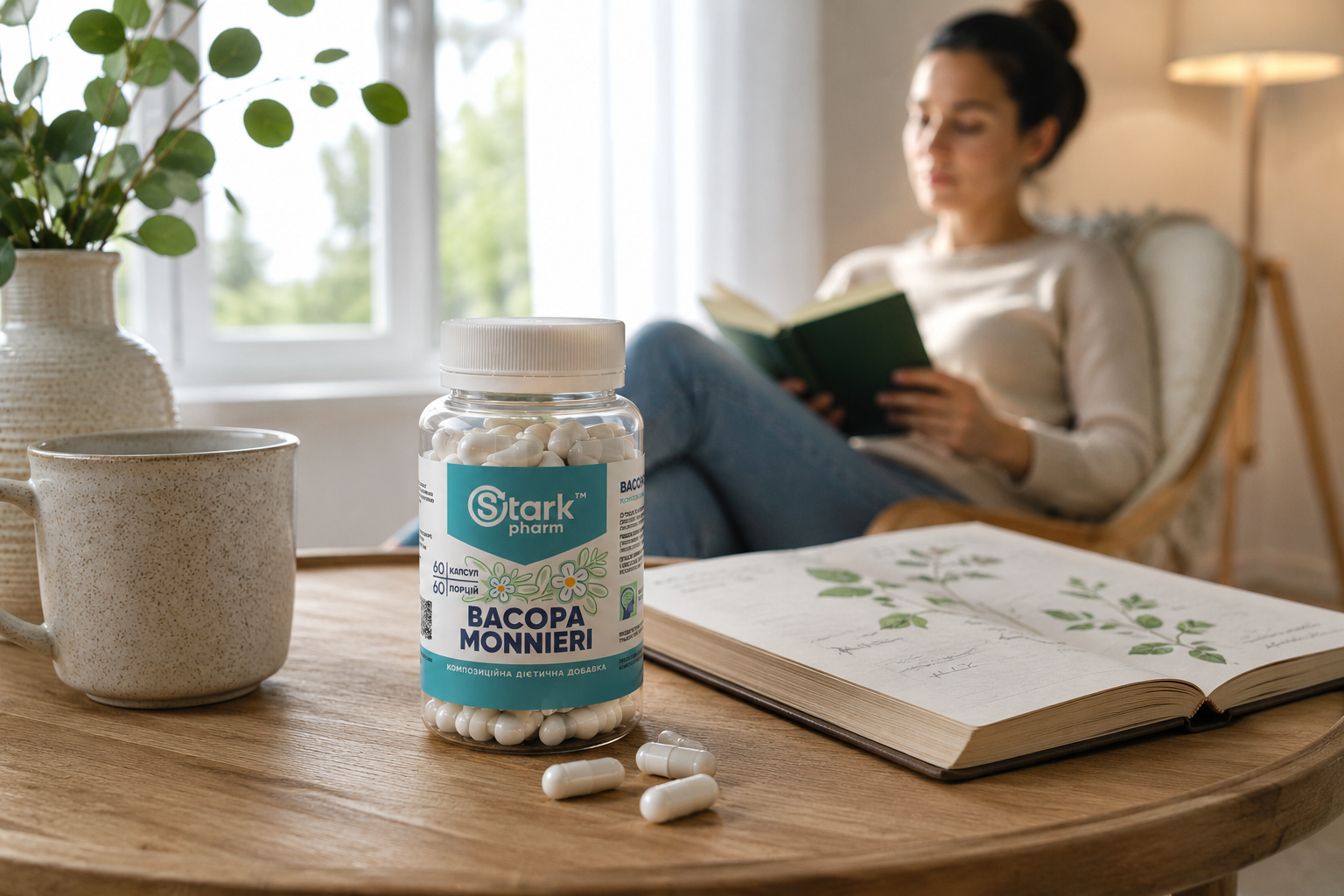
Bacopa monnieri is of interest mainly to people with intense mental workloads who are looking for herbal support for memory and concentration within a balanced diet. It is not recommended for children under 18 years of age, pregnant women, and lactating women. The duration of continuous use is traditionally limited - after a few weeks of the course, a break is usually taken, rather than taking the supplement continuously without a break. Before taking it, especially if you have chronic diseases or are taking medications, it is worth consulting a doctor; the most common side effects in studies were from the gastrointestinal tract (nausea, bloating, more frequent bowel movements).
Frequently asked questions
What are bacosides?
Bacosides are a group of triterpene saponins (mainly bacoside A and bacoside B) in the Bacopa monnieri plant, to which the plant's main pharmacological activity is attributed.
How long did human studies of bacopa last?
Most controlled studies with positive results lasted 12 weeks; some studies evaluated intermediate points at 5 weeks, where the effect was not yet fully apparent.
When does the effect of taking bacopa appear?
According to available data, the effect on memory and information processing speed develops gradually and becomes statistically significant mainly after 8–12 weeks of regular intake, and not immediately.
Can I take bacopa for a long time without a break?
Most controlled studies have evaluated use for 12 weeks; data on the safety of continuous use for more than a few months is limited, so periodic breaks are traditionally recommended.
What are the differences between different standardized bacopa extracts?
Commercial extracts (e.g., CDRI-08, BacoMind, Keenmind) differ in production method and ratio of individual bacosides, so research results from one extract cannot be automatically transferred to another.
Who is not recommended to take bacopa without consulting a doctor?
Children under 18 years of age, pregnant women, lactating women, as well as people who take medications on a regular basis.
Are there any side effects of bacopa?
In controlled studies, the most commonly reported side effects were gastrointestinal—nausea, bloating, and increased bowel movements; no serious side effects were reported.
Sources
- Stough C. et al. (2001). The chronic effects of an extract of Bacopa monniera (Brahmi) on cognitive function in healthy human subjects. Psychopharmacology. PubMed
- Calabrese C. et al. (2008). Effects of a standardized Bacopa monnieri extract on cognitive performance, anxiety, and depression in the elderly. Journal of Alternative and Complementary Medicine. PubMed
- Morgan A., Stevens J. (2010). Does Bacopa monnieri improve memory performance in older persons? Journal of Alternative and Complementary Medicine. PubMed
- Peth-Nui T. et al. (2012). Effects of 12-Week Bacopa monnieri Consumption on Attention, Cognitive Processing, Working Memory, and Functions of Both Cholinergic and Monoaminergic Systems in Healthy Elderly Volunteers. Evidence-Based Complementary and Alternative Medicine. Wiley
- Pase MP et al. (2012). The cognitive-enhancing effects of Bacopa monnieri: a systematic review of randomized, controlled human clinical trials. Journal of Alternative and Complementary Medicine. PubMed
Dietary supplement. Not a medicine. Consult a doctor before use.
Products related to this post
Comments
Information
Customer Service
Extras
My Account


Sports nutrition manufacturer in Ukraine StarkPharm © 2026